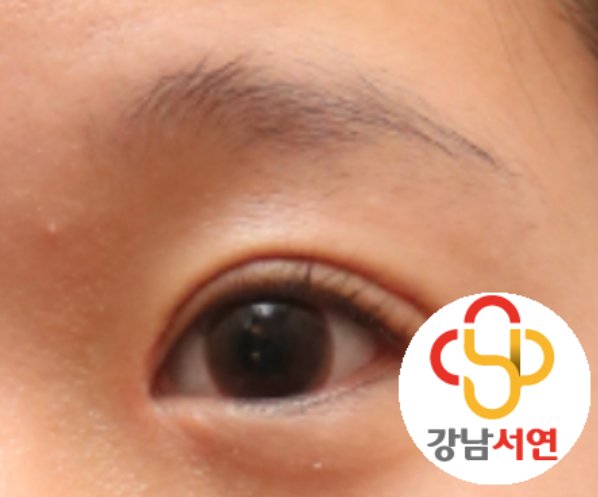
A patient came in for a revision consultation and told me that a surgeon at another clinic had insisted the scar-preserving high fold correction was a procedure to avoid at all costs.
For readers unfamiliar with the term 두줄따기 — the scar-preserving high fold correction, colloquially the "two-line" technique — please see the earlier post below first.
Scar-Preserving High Fold Correction: Revising Heavy Sausage-Lid Folds
Material I lectured on at a 2016 conference, written up for the blog in 2018.
Is the scar-preserving high fold correction genuinely a surgery to avoid?
As the linked post explains, the ideal approach excises the scarred strip — including the previous scar — and lowers the crease.
If we can excise the scar and rebuild the crease using healthy tissue, that's clearly the best option — leaving a single scar line and using a softer fixation.
Here's the catch: if the patient does not have spare skin to give up, excising it leaves them with a true complex double eyelid revision case — one where further revision is no longer possible.
Most patients who end up needing a scar-preserving high fold correction are already complex double eyelid revision cases, but they fall into the category that can still be operated on.
Excising the skin when there isn't enough to spare turns it into a complex double eyelid revision case that can no longer be revised at all.
Another consideration: the scar-preserving high fold correction is a procedure that demands a board-certified plastic surgeon with deep mastery of eyelid surgery.
Without that level of training, severe multiple upper eyelid creases and various other complications can develop. If a surgeon cannot manage these complications, skipping the procedure is the better choice. It's worth considering that a non-board-certified surgeon may simply be unable to perform it — which would explain the blanket warning.
Early Revision After a Failed Scar-Preserving High Fold Correction (with Triple Folds)
This kind of complication with multiple upper eyelid creases can develop.
When that happens, the right response is active treatment rather than waiting for it to resolve on its own.
"A scar-preserving high fold correction creates two scar lines and produces a step (단차)" — really?
That's a misconception.
Scarring After Scar-Preserving High Fold Correction and Low Crease Incisional Surgery
The "step" is something that appears whenever the crease sits lower, and it shows up routinely in first-time surgeries — particularly in male hidden-fold cases.
It happens because skin overhangs and partially covers the crease — the lower the crease, the more pronounced this becomes. Even patients who already have a natural crease will develop the same step over time, as aging skin droops over the line.
So this is how the lid is supposed to look — a normal feature of the anatomy rather than a complication.
If anything, this is something a non-specialist might genuinely misunderstand.
Always verify that your surgeon is a board-certified plastic surgeon.
In my own consultations, I begin by examining the patient's anatomy.
When there's enough spare skin, my default is to excise the scarred strip.
When skin is limited, I begin with a scar-preserving high fold correction; if more skin proves available mid-procedure than expected, I may excise some — always with the patient briefed in advance.
In rare cases where the skin is short and pulled tight, simply opening the incision and converting to a softer, lower fixation can drop the crease. This is uncommon and applies only to a narrow set of cases.
If the skin is present but heavily scarred, a scar-preserving high fold correction can leave some post-op crinkling. We discuss this with the patient in advance before proceeding.
It's a matter of weighing the gains against the costs.
If a non-specialist has warned you off the scar-preserving high fold correction, here are a few things worth considering.
On online forums, you'll find posts arguing that a barely-scarred scar-preserving high fold correction somehow worsened the eye — usually because the writer wasn't aware of the pre-op baseline, or held expectations the procedure was never going to meet. In most cases, the post-op state is genuinely better than what came before.
Second, non-board-certified surgeons posing as specialists may dismiss the procedure precisely because they cannot perform it. Some claim "the scar-preserving high fold correction is a last-resort procedure" under the guise of patient advocacy. The reality is the opposite: excising skin when there isn't enough to spare is what creates the last-resort scenario, leaving the eye beyond further revision.
Third, patients with good outcomes typically post a short review at most and move on. The persistent online writers tend to be the ones with failed cases, personal dissatisfaction, or strong but mistaken beliefs about a result that was actually fine. A handful of vocal posters can make a procedure look universally unwise, even when most patients are doing well.
Fourth, you may be told that fat grafting or ptosis correction must accompany a scar-preserving high fold correction. Neither is required. Fewer than 5% of my scar-preserving high fold corrections include either.
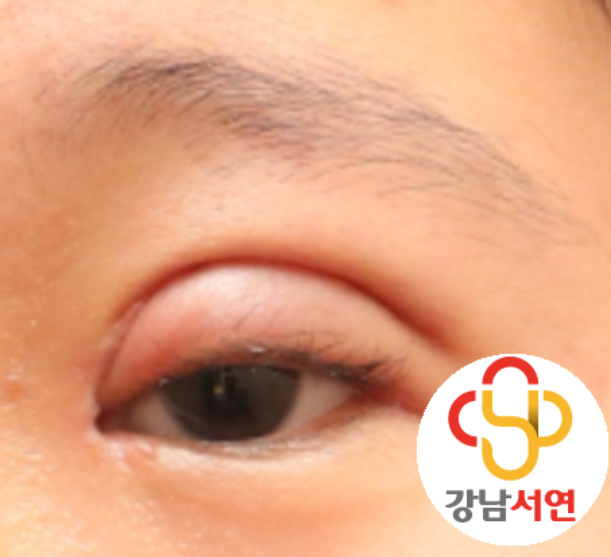
When a crease sits this absurdly high, excising skin would be a serious mistake, and trying to shape the lid through the existing incision line is a non-starter from the outset.