
I settled on this title for the post.
She found us through an online search. Most of our patients come through referrals, but online discovery happens occasionally.
After her original double-eyelid surgery, the crease had formed along the incision line.
The upper arrow points to a line that formed from a deeper adhesion above the incision; the lower arrow points to the original incisional crease.
So instead of the crease forming at the original incision, it formed at a higher point — and not even at the original incision but above it.
The deeper tissue was strongly adhered, and there was a volume deficit. This produces the sausage-roll look.
Sausage, sausage-roll, however you want to spell it.
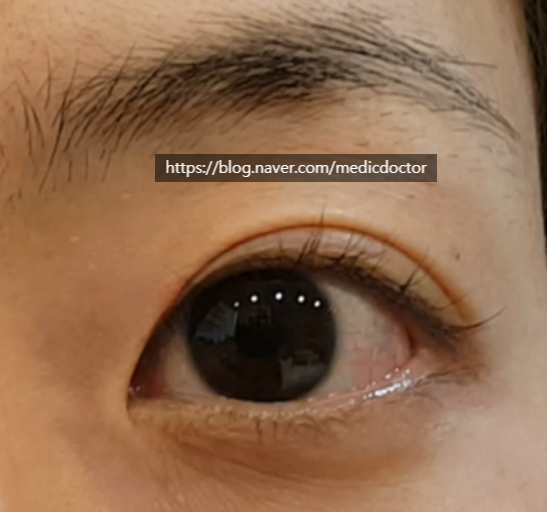
Her other eye showed a clean crease formed along the original incision.
The plan was to reset the crease cleanly and bring the contralateral medial portion down a touch as well, so the line shows slightly more there.
Some patients only want one side revised. In my experience, when the same surgeon is refining one side for symmetry, single-side surgery can work; when the original surgery was done by a different surgeon, technique differences can show, and I usually recommend revising both sides.
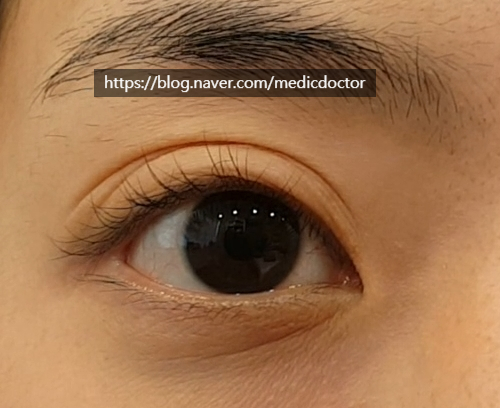
The arrow-free version of the same image.
The surgical plan: prevent re-adhesion at the deeper plane and reinforce volume above the incision.
From an old conference lecture of mine, for context:
This is from a 2016 lecture I gave at the invitation of Dongguk University's Department of Plastic Surgery.
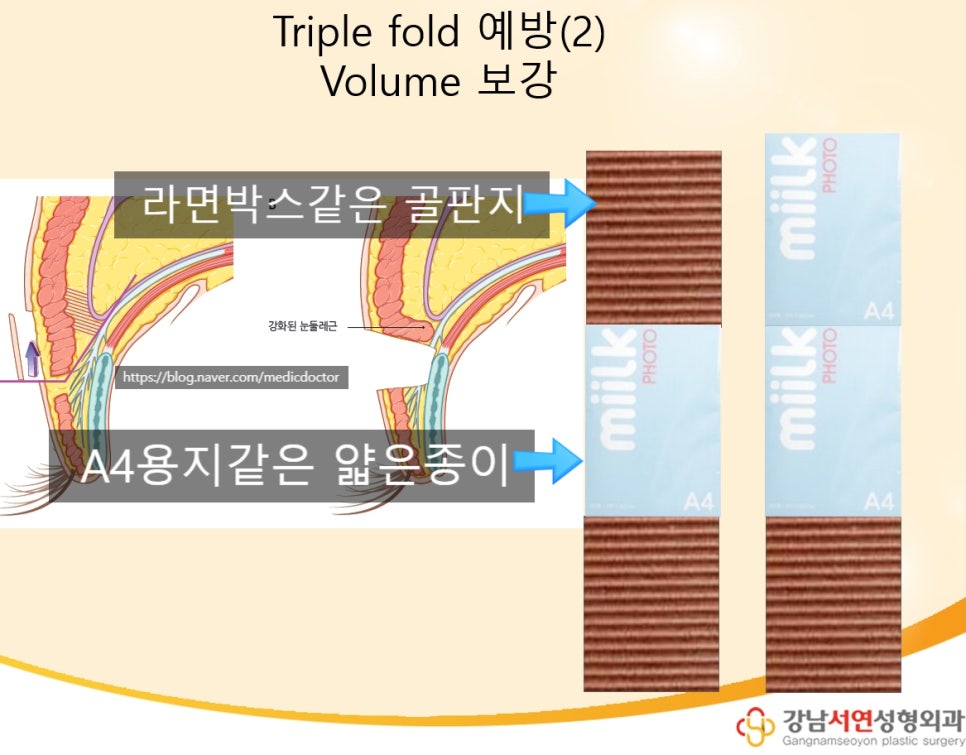
Imagine you glue a thick board, a thin sheet of paper, and a piece of corrugated cardboard side by side. When you try to fold the stack, the corrugated cardboard is rigid, so the fold has to happen in the thin paper.
Now imagine on the right side you stack two thin sheets of paper above the cardboard. The cardboard still will not bend, but the upper layers can fold either at the top or in the middle.
Standard double-eyelid anatomy is essentially cardboard – A4 paper – cardboard. The fold forms in the A4 zone; the cardboard above represents the area near the brow, and the cardboard below represents the area near the lash line.
If the skin near the brow is thin and there is also adhesion there, the result is a triple fold.
If a fellow plastic surgeon happens to be reading along, this should be useful background.
Three things matter most in this surgery: reinforcing volume above, releasing the adhesion, and preventing re-adhesion.
We released the adhesions and reinforced the volume just below the brow.
One week post-op.
The correction looks good. The patient asked one question.
She felt a faint additional line forming above the new crease. For a moment I wondered if it was a re-adhesion, but re-adhesion is uncommon in experienced hands.
Let me explain with a diagram.
Some readers will already have figured it out: when a crease has been folded along the same line for a long time, a faint wrinkle can persist.
It is not that the triple-fold correction failed — it is that the long-standing fold has left a residual crease memory in the skin.
Patients with naturally small eyes who chronically lift their forehead develop deep forehead lines for the same reason.
Once we correct the underlying issue with ptosis correction or skin tightening, they stop lifting the forehead — but the wrinkles remain.
In younger patients those lines fade significantly with time, often to where you stop noticing them.
She is one week out and the bruising along that line makes it look more pronounced. There is no cause for concern.
I will post a longer follow-up when she returns.