
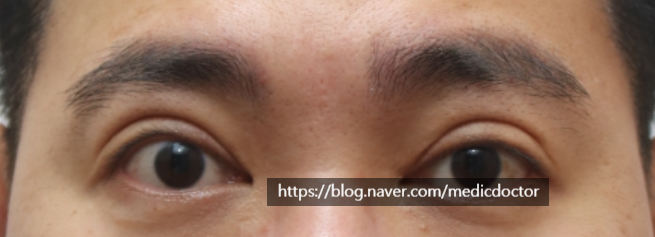
Looking at this patient's eyes, the left looks acceptable,
but the right looks startled — wide open in a way that does not match the other side.
The contrast is clearer at higher magnification.
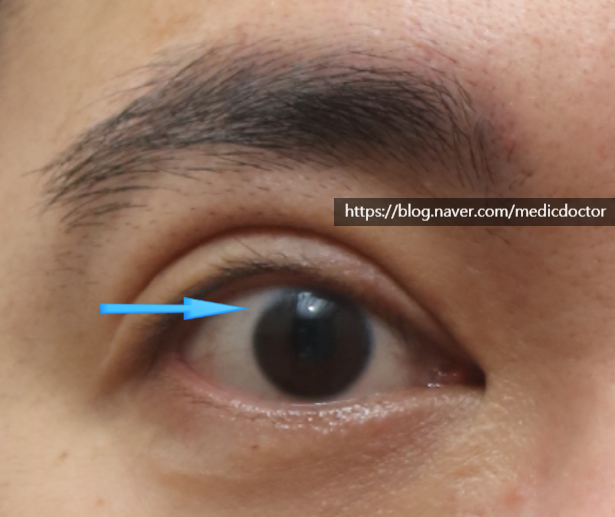
The sclera is showing under the iris.
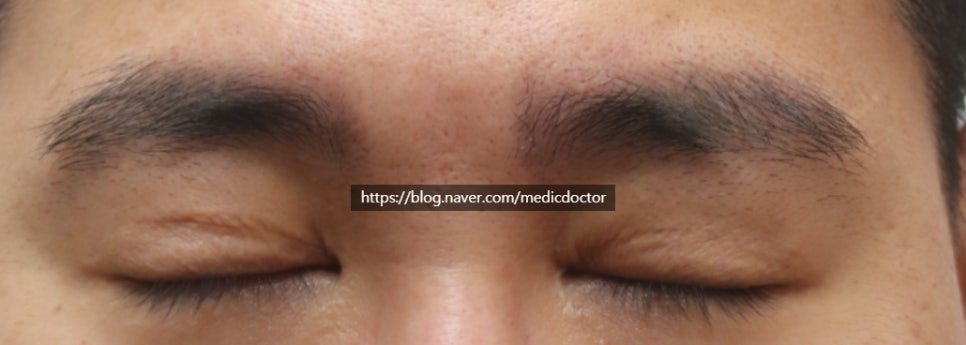
Closed-eye view: heavy scarring and an unreasonably high crease. A textbook sausage fold.
Most male patients want a hidden crease with a larger-looking eye.
To achieve that, the crease has to be set low and the upper skin has to drape over to cover it.
What I mean by that:
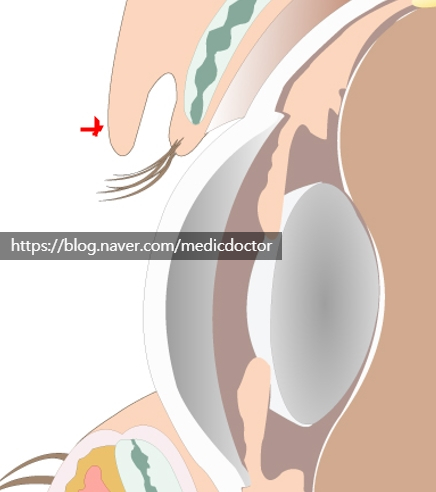
The red-shaded area represents the skin that should drape forward and conceal the crease.
This patient was thin on tissue above the crease, with significant scarring — a high re-adhesion risk.
Re-adhesion prevention requires several techniques. We used a material I have been studying with a Korea University faculty group as one of those tools, and we repositioned fat in addition.
Eyelid retraction repair is particularly prone to re-adhesion because the levator rides upward. The mechanism is technical, so I will skip the details.
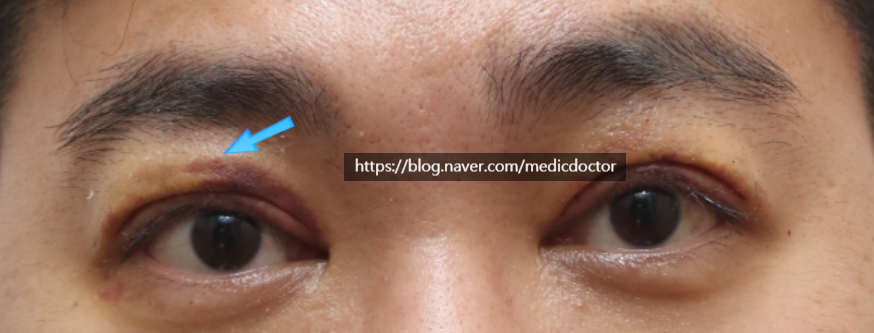
One week post-op. His right eye (the left side of the photo) has the lower crease and the retraction is corrected.
But the work is not over. Re-adhesion typically appears between two weeks and two months out.
I expected this patient to follow that pattern. Even at one week, you can see a faint trace of the original crease re-folding.
One-month follow-up.
He told me that when he opened his eyes a little harder, an extra fold appeared above the new line.
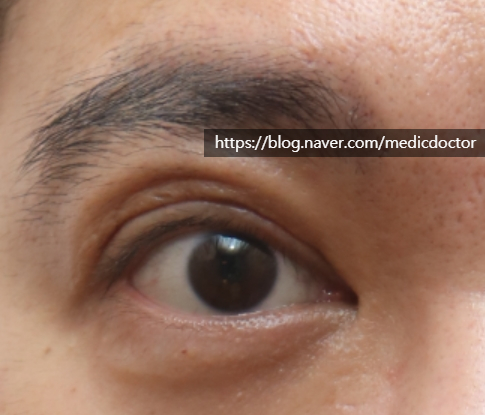
I had anticipated this, so I reassured him and explained that it would resolve with time.
The cause was not adhesion above the line. It was a volume deficit above (slight depression) combined with residual swelling below the crease that prevented the upper skin from dropping into place.
Patients who have been through several prior surgeries carry significant anxiety, and they often struggle to trust the surgeon or worry that this revision will fail too.
This patient trusted me through the process.
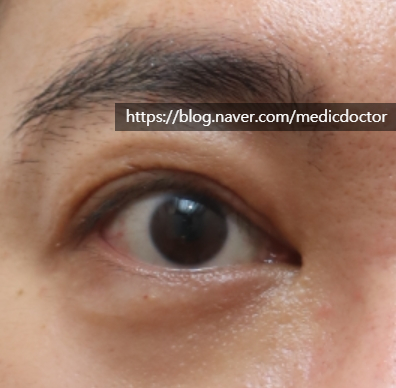
Three-month follow-up. Even with the eyes opened wide, the upper line does not form, because the swelling below the crease has resolved.
Six-month final view. The crease is low, the retraction is corrected, and there are no multiple upper eyelid creases.
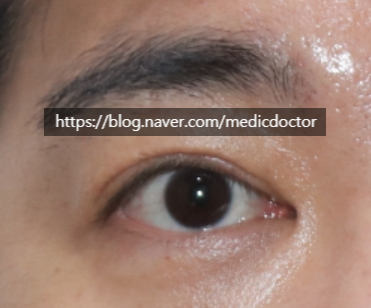
As before: the photos are real patient images, no Photoshop or post-processing — only cropping with Alcapture.
Pre-op vs. six months post-op.