
A walkthrough on eyelid retraction repair.
First, what is eyelid retraction? It helps to start with what a normally proportioned upper lid should look like.
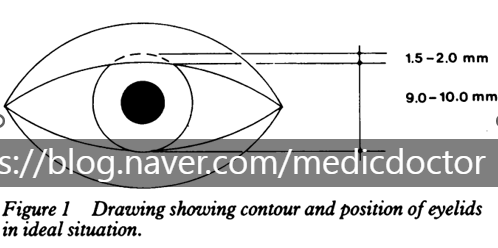
In a normal eye, the upper lid covers the iris by 1–2 mm.
When that doesn't hold —
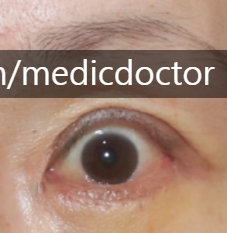
and the eye opens this widely instead — we call it eyelid retraction.
Pathological causes include hyperthyroidism (thyroid eye disease) and, occasionally, congenital presentations.
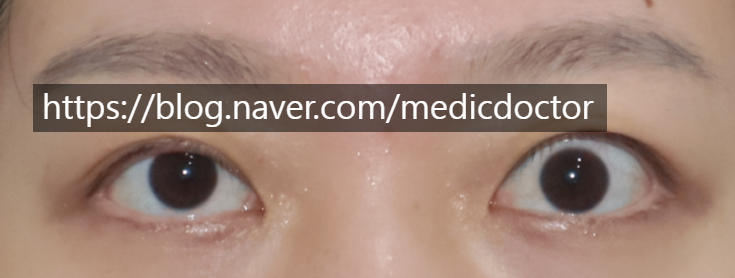
This patient had never undergone surgery, yet her eye still opened this widely.
Today's case is a patient I operated on a year ago who returned for a follow-up — a fitting moment to share the result.
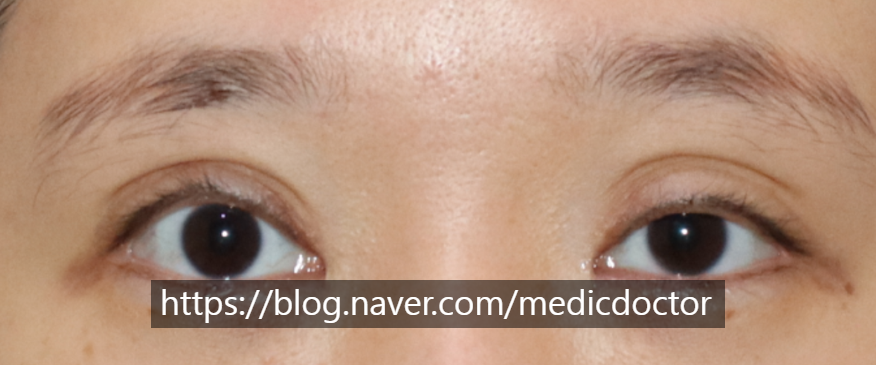
One side showed multiple upper eyelid creases together with retraction; the other side had multiple upper eyelid creases alone, with a comparatively smaller aperture.
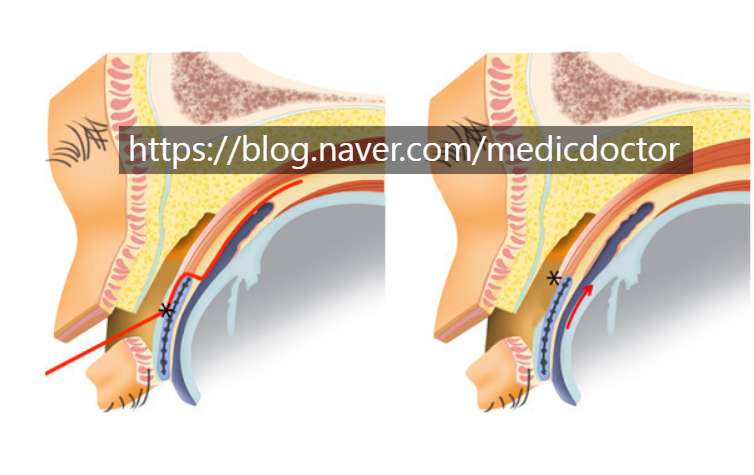
Repair requires separating the levator above the tarsal plate completely, and releasing every adhesion that runs down to the conjunctiva.
Simply removing the ptosis-correction sutures does not solve this. See the earlier post below for reference.
https://blog.naver.com/medicdoctor/222790575523
We also performed a scar-preserving high fold correction to lower the crease at the same time.
Combining retraction repair with crease lowering is technically demanding — multiple upper eyelid creases are easier to develop, and the surgeon has to anticipate every contingency.
For this patient, we performed crease lowering and retraction repair alone, with no fat grafting.
Some patients believe a scar-preserving high fold correction must include fat grafting or ptosis correction. Performing it without either takes considerably more skill.
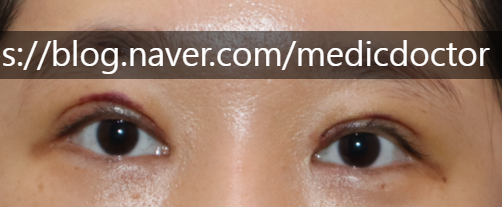
One week post-op.
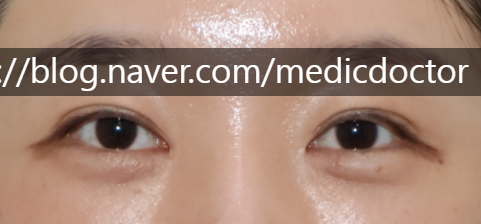
One year post-op.
I'm pleased with how it turned out — and the patient is happy with it, which means a lot.