
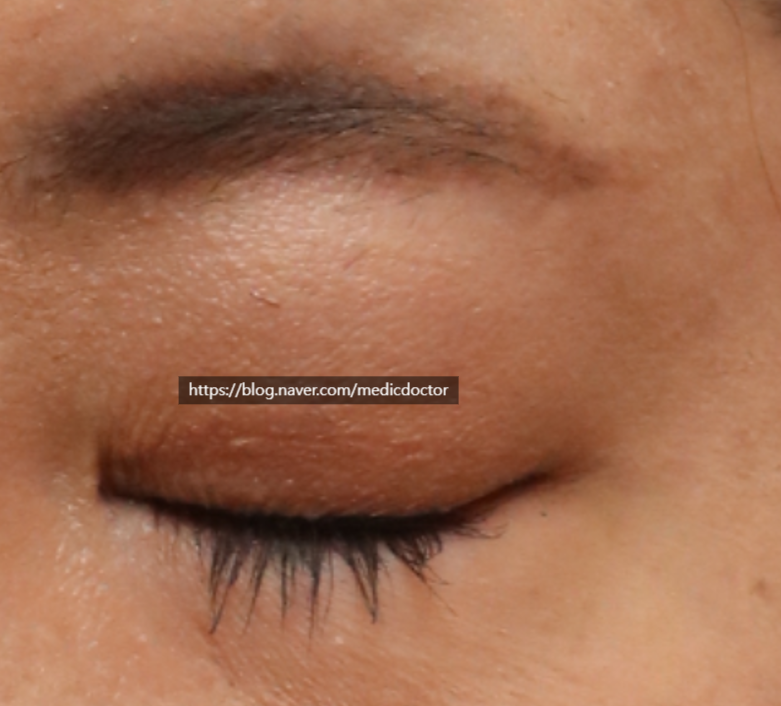
<Eyelid scar at six months post-op>
In recent consultations, I've been seeing patients who are distressed about scarring from a previous eyelid surgery.
Any surgery that uses an incision leaves a scar — the only tissue that heals without one is mucosa.
There are absolutely ways to minimize scarring, particularly during a first surgery.
The trade-off: minimizing tissue trauma and conservative excision reduces scarring but raises the chance of the crease coming undone.
Balancing the two is the surgeon's job.
Does Incisional Ptosis Correction Leave a Heavy Scar?
A post I wrote five years ago.
What's possible during a first surgery is one thing. Revision surgery is an entirely different matter.
We clean up the surrounding scar tissue, draw in healthy tissue from nearby, lay it flat, and reinforce the area.
All to make the result look as clean as possible.
The key word here is "effort." Whether the scar improves cannot be guaranteed.
Once we open the lid, if there is no healthy tissue available to use as a graft, the scar simply cannot be improved.
Imagine telling a patient mid-surgery that the scar improvement isn't going to be possible —
the disappointment for the patient would be devastating.
For that reason, I do not operate purely for scar improvement.
When the procedure is a first surgery, as in the older post above, I know a number of techniques for minimizing scarring and making it less visible.
But when there is no usable tissue, there is nothing surgery can do. Patients sometimes ask, in consultation, what percentage improvement they can expect.
One clinic told them 60%, another said 70%.
But can scar improvement really be quantified as a percentage? An invisible scar is close to 100%; a visible one might as well be 0%.
If the surgeon claims 60% improvement and the patient sees 10%, what's to be done about the 50% gap?
Insisting on the higher number won't change anything.
In revision cases, I almost always tell patients up front that scar improvement should not be expected. We do everything we can to make it less visible, and most patients have been satisfied with the post-op scar quality our clinic delivers — as documented across our blog and YouTube channel.
One-Year Scar Course After Scar-Preserving High Fold Correction
After a scar-preserving high fold correction, two parallel scars are unavoidable — though they tend to soften considerably with time.
Walking Through a Scar-Preserving High Fold Correction Case
Asymmetry Correction Review — Understanding the Principles, and Why Price Isn't Everything
This is exactly why the first surgery is the one most likely to leave the smallest scar.
I'll bring every technique I know to keeping the scarring as light as possible.
That said — I do not guarantee any specific outcome.