
A few notes on this topic.
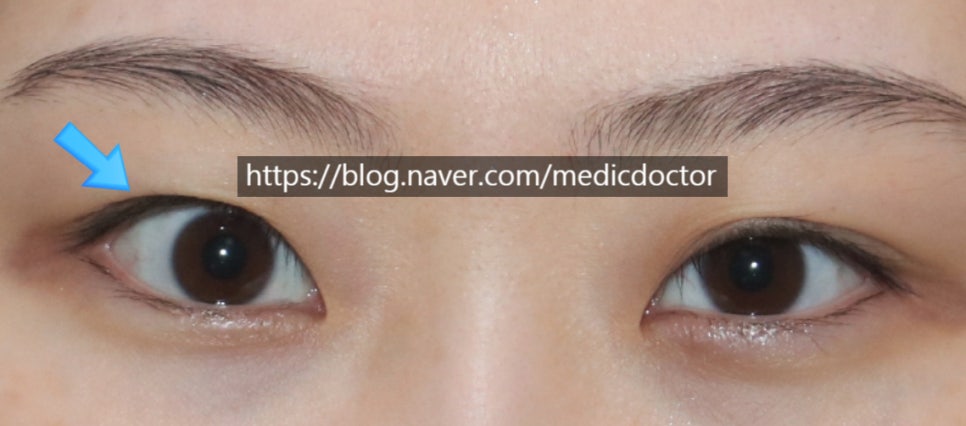
On the patient's right eye (the left side of the photo), substantially more sclera is exposed compared with the other side. Follow the arrow.
Easier to see at higher magnification.
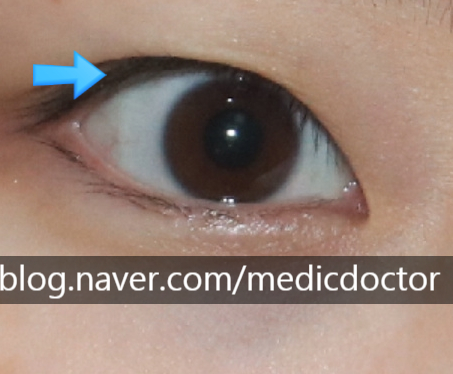
Several years out from her original surgery.
The intuitive question is: can we just release the ptosis-correction suture and have the lid drop back down?
No. This is not a release procedure. It is a separate operation called eyelid retraction repair.
Technique-wise, we dissect from the levator down through Müller's muscle and all the way to the conjunctiva.
The idea is to recreate a controlled ptosis intraoperatively and then perform a fresh ptosis correction on top of it.
The most common pitfall: under local anesthetic the eye looks adequately closed and the retraction repair appears successful — yet most cases relapse over time.
Volume builds the intuition for this.
Her other eye looked only mildly sleepy and I expected very little ptosis work would be needed; once we were inside, however, the levator was clearly disinserted.
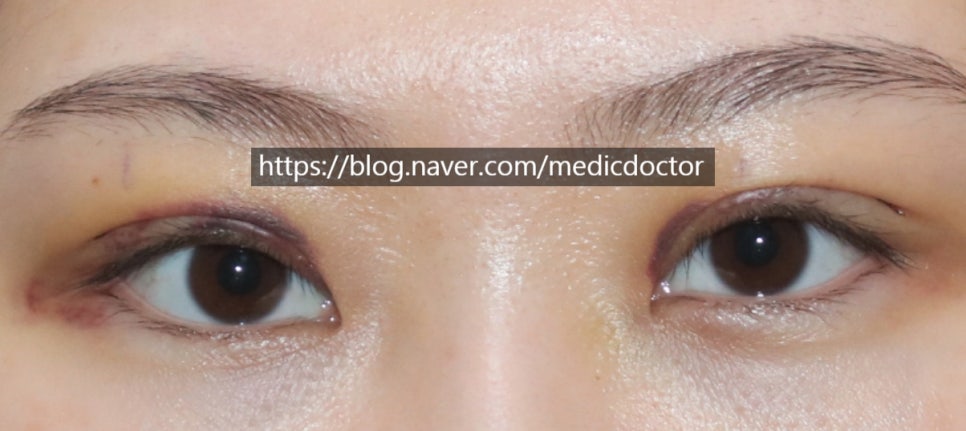
Day five post-op. The patient came in mid-recovery to make sure things were settling correctly.
The retraction repair held well, and symmetry looks good so far.
Vigilance is essential. As I explained to her, between one and two months out, scar contracture and other factors can cause the eye to widen again. That is the dilemma — re-open and add more retraction repair, or wait.
That decision is mine to make in collaboration with the patient, built on trust.
She is only five days out and still swollen. Both eyes will open a little wider as swelling settles, and the crease should soften further.
Pre-op video.