
Hello, I'm Dr. Choi Dong-il of Gangnam Seoyon Plastic Surgery.
Do you look tired every time you check the mirror, no matter how much sleep you get? If dark circles or hollowness under the eyes are the culprit, the shadow you see — one that persists even with plenty of sleep or a full face of makeup — is often caused by the under-eye fat pads themselves. Today, I'll walk you through everything about lower-eyelid fat repositioning (transposition): how it works, pre- and post-operative care, potential side effects, and the likelihood of recurrence.
This shows the lower-eyelid fat repositioning process. Please refer to the YouTube video above.
1. What Is Lower-Eyelid Fat Repositioning (Lower Blepharoplasty)?
Lower-eyelid fat repositioning is not about removing the fat that bulges under the eyes — it's a technique that spreads and redistributes that fat evenly into the darker, hollowed areas around the eyes.
As we age, the orbital septum that supports the under-eye fat weakens, allowing the fat to push forward and create a visible bulge — a condition known as under-eye fat protrusion. At the same time, the area the fat has shifted away from, the tear trough, becomes hollow, casting a shadow that looks like dark circles.
In other words, lower-eyelid fat repositioning addresses
- Protruding, bulging fat
- A hollow, sunken tear trough
- The resulting dark circles and under-eye sagging
all at once — a comprehensive solution that makes it a popular choice among patients.
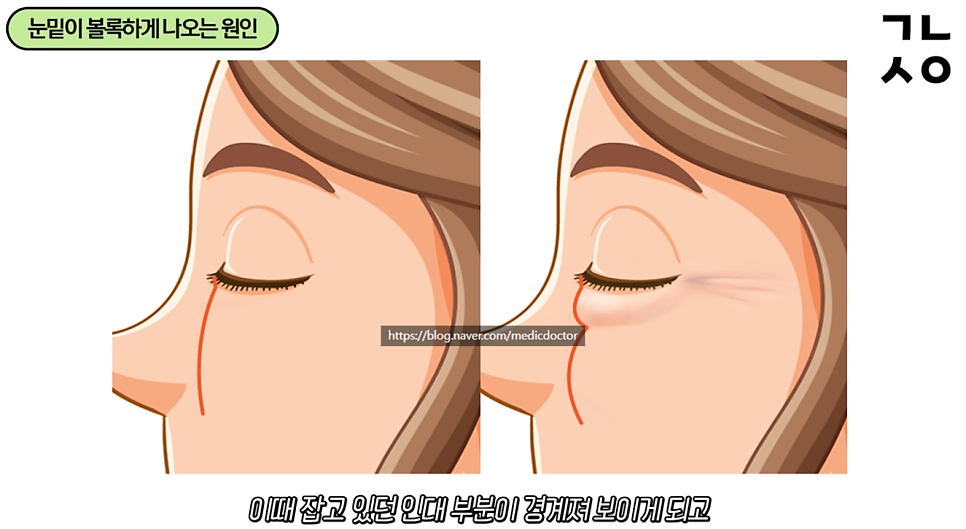
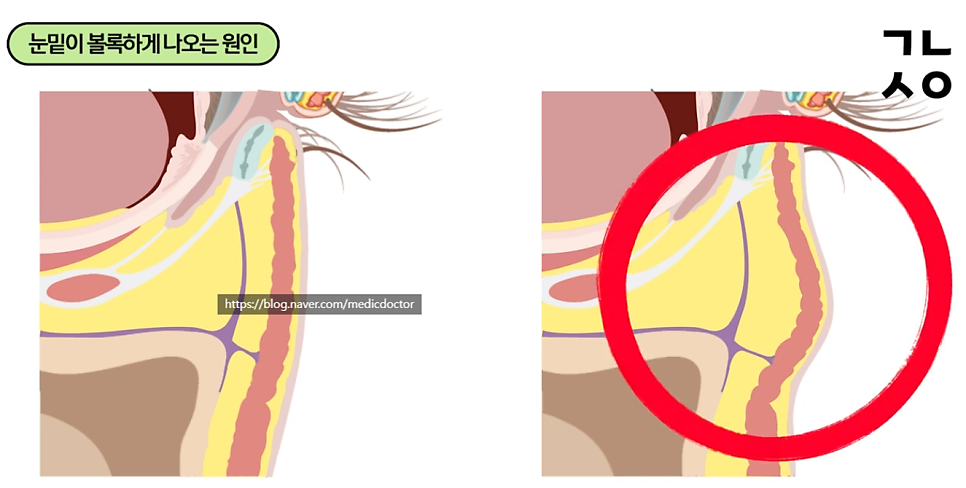
Diagram: this cross-sectional illustration of lower-eyelid fat repositioning (lower blepharoplasty) shows the structure of under-eye fat protrusion and tear trough hollowing.
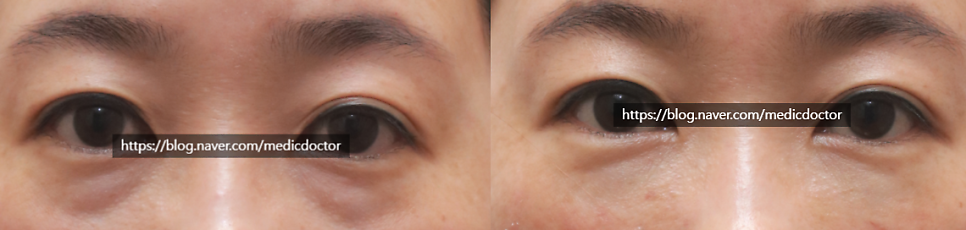
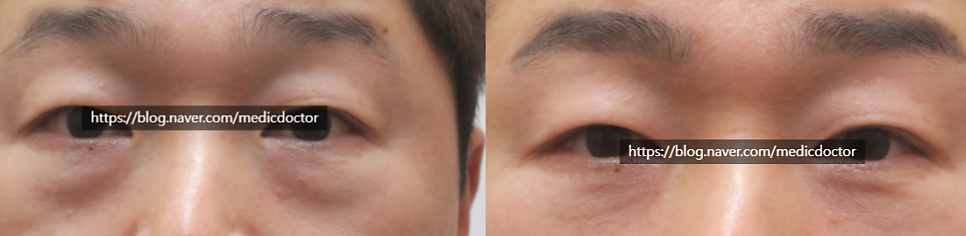
Before-and-after photos
2. How the Surgery Works: Principles and Procedure
Lower-eyelid fat repositioning is performed without cutting the skin. Instead, a laser is used to make a small incision in the conjunctiva (the inner mucous membrane of the eyelid). Through this incision, the protruding under-eye fat is spread evenly and shifted into the hollow tear trough area.
▶ Surgery time: Approximately 30 minutes to 1 hour
▶ Anesthesia: Sedation (twilight) or local anesthesia (determined through consultation)
▶ Recovery period: Approximately 1 week
▶ Scarring: None on the skin, since the procedure is performed through the conjunctiva
Because there's no skin incision, recovery is fast and returning to daily life is easy — a major advantage. These days, however, surgeons often go beyond simply repositioning the fat: to prevent recurrence, the orbital septum surrounding the fat is reinforced at the same time through a technique called septal reinforcement (septum strengthening).
3. Pre-Operative Precautions
For a safe and satisfying outcome, please be sure to follow the guidelines below before surgery.
■ 1 Week Before Surgery
- Stop taking aspirin, anticoagulants, vitamin E, and other medications that interfere with blood clotting
- Take measures to prevent swelling and bruising
■ 3 Days Before Surgery
- Avoid heavy alcohol consumption
■ Day of Surgery
- A light meal is recommended
- Fasting is required starting 2 hours before surgery
Pre-surgery checklist
4. Post-Operative Care (Managing the Recovery Period)
Light daily activities and even returning to work are possible right after surgery, but you should expect some swelling that may last 3 to 5 days, depending on the individual.
■ Allowed Immediately
- Washing your face
■ To Avoid for 1 Week
- Baths, saunas
- Wearing contact lenses (glasses are recommended instead)
- Strenuous exercise
- Alcohol and smoking
■ Allowed After 3 Weeks
- Swimming and other water activities
■ Tips for a Faster Recovery
- Avoid strenuous physical activity
- Sleep with your head elevated above heart level (to prevent swelling)
This may seem like a lot to keep track of, but if you manage the first 1 to 2 weeks carefully, you can expect a great result without worrying about inflammation or pain.
5. Side Effects and Solutions — What If Dark Circles Seem to Get Worse?
Some patients report that their dark circles seem to have worsened after lower-eyelid fat repositioning. This can generally be attributed to one of three causes.
① A Temporary Reaction During Recovery
Dark circles can temporarily appear worse during the early recovery process right after surgery. In most cases, this naturally improves within a few weeks, depending on your individual healing pace.
② Insufficient Fat Graft Survival (Fat Take)
If the repositioned fat does not survive well, dark circles may appear more pronounced. In such cases, improvement is possible with dermal injections (Re2O) or hyaluronic acid-based hydro-lifting.
③ Untreated Dark Circles from Other Causes
If dark circles are also caused by factors other than under-eye fat — such as thin skin or pigmentation — failing to treat those causes as well can limit the improvement. A combination treatment tailored to the specific cause of your dark circles is necessary.
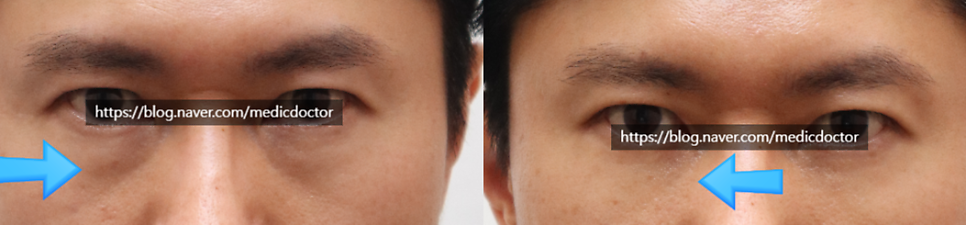
6. When Is the Best Time to Get Lower-Eyelid Fat Repositioning?
Many patients who develop under-eye fat protrusion at a young age wonder, "Should I get treated now, or wait until it gets worse?"
To give you the short answer first: if the protrusion is objectively visible and it bothers you, we recommend not waiting too long and seeking treatment early. Since septal reinforcement is now commonly performed alongside laser fat repositioning to prevent recurrence, patients who are treated at a younger age — before the protrusion becomes severe — tend to see better results that last longer.
7. Lower-Eyelid Fat Repositioning and Skin Elasticity
Because laser lower-eyelid fat repositioning does not involve cutting the skin, this procedure alone cannot correct sagging caused by reduced skin elasticity.
However, a variety of laser devices and thread-lifting treatments have advanced considerably in recent years, offering effective ways to improve skin elasticity and sagging at the same time. If sagging skin is also a concern for you, combining fat repositioning with a lifting treatment can deliver an even more satisfying result.
8. Why Recurrence Is Rarely a Concern After Treatment
If your treatment follows these two principles, you can largely set aside your worries about recurrence.
First, since under-eye fat is generally divided into three compartments, all three must be treated evenly during surgery, without leaving any compartment untreated.
Second, the surrounding tissue that encases the fat — the orbital septum — must be treated as well. If the fat is simply repositioned or removed on its own, it can sag again over time; but tightening the septum along with it keeps the results stable for years.
It's also reassuring to know that, because laser lower-eyelid fat repositioning is performed through the conjunctiva, additional revision surgery remains entirely possible in the rare case that recurrence does occur.
9. Frequently Asked Questions (FAQ) -
Q. Does lower-eyelid fat repositioning leave a scar?
A. Since the procedure is performed through the conjunctiva, no scar is left on the skin.
Q. How long is the recovery period for lower-eyelid fat repositioning?
A. It varies by individual, but swelling typically subsides within about a week, and you can return to daily activities right after surgery.
Q. Will dark circles disappear completely with fat repositioning alone?
A. Dark circles caused by fat protrusion will improve, but if pigmentation or thin skin is also a contributing factor, additional combination treatment may be needed.
Q. Is there an age limit for lower-eyelid fat repositioning?
A. There is no strict age limit, but results tend to last longer when the procedure is performed at a younger age, before the fat protrusion becomes severe.
10. Closing Thoughts
Lower-eyelid fat repositioning is an effective treatment that can address multiple concerns at once — dark circles, tear trough hollowing, and under-eye sagging. However, since the condition of each patient's under-eye fat and the cause of their dark circles differ, it's essential to establish a treatment plan tailored to you through a thorough consultation with a specialist.