
Today's post is on post-operative care after eyelid surgery.
We go over instructions in the office before patients leave, but they often forget the details once they are home and still recovering. So I am putting it in writing.
This applies to upper blepharoplasty, lower blepharoplasty, double-eyelid surgery, medial epicanthoplasty, lateral canthoplasty, and so on.
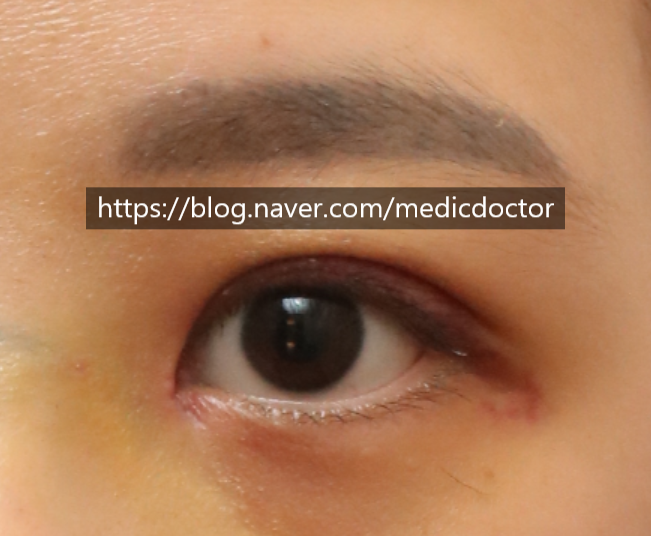
Different clinics and different surgeons have different post-op preferences, so what I write here is not the only valid protocol. These are the recommendations I give my own patients.
1. Preventing adhesions in the wrong places.
After surgery, I have my patients practice opening the eyes wide as much as possible.
This is especially important after revisional double-eyelid surgery. I tell patients to stay up later than usual, watch a late movie, anything to keep the eyes active.
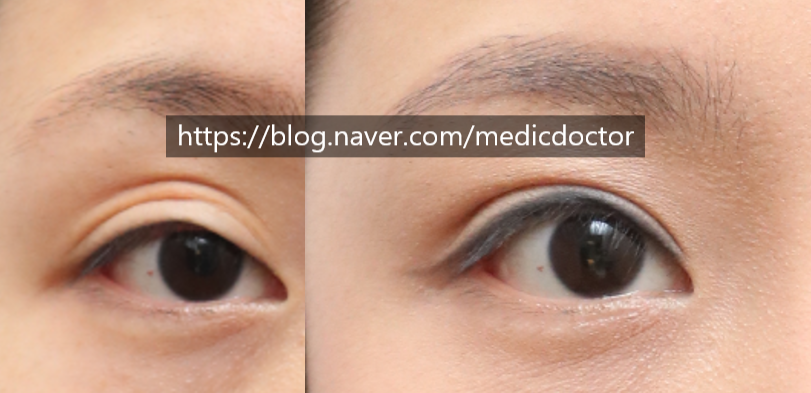
If the patient has heavy pre-existing scarring, re-adhesion can pull the crease line into the wrong place. In ptosis-correction cases, scar adhesion at the corrected site can re-shrink the eye opening even though we made it larger.
When that happens unilaterally, you end up with new asymmetry.
2. Cold compresses.
Should you use cold compresses?
Light compresses can help when there is pain, but I do not believe heavy use of cold compresses speeds up swelling resolution in any meaningful way.
In fact, lying with a closed eye under a cold pack is, in my view, less helpful than the eye-opening exercises above.
There is also the risk that condensation from the ice pack drips into the wound and causes inflammation. So I recommend cold compresses only intermittently, when there is real pain.
3. Crusting (clotted blood).
When dried blood forms a crust on the lid, it needs to be removed gently.
After my own cases, I do not place a gauze dressing over the lid.
I find gauze interferes with eye opening. This is just my preference.
Right after surgery, you will have some clotted blood at the wound.
Apply a small amount of ointment with a cotton swab and the crust will soften and lift off cleanly.
Or moisten clean gauze with saline and gently lift the crust away.
Heavy crusting is unsightly during recovery and can interfere with smooth scar healing.
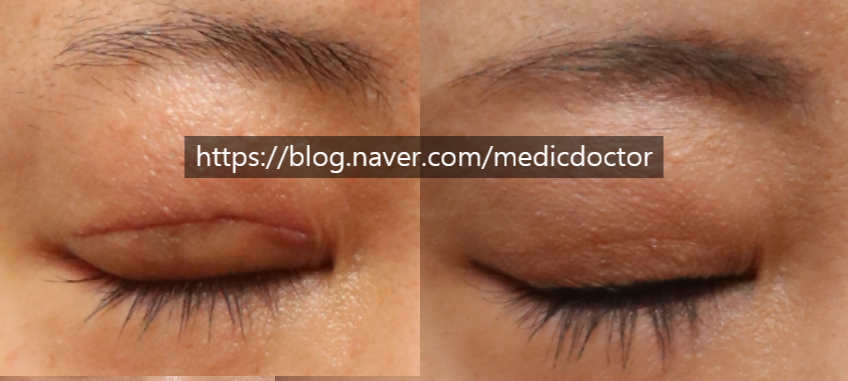
If the crust is heavy, apply a generous amount of ointment and wait about two hours. The crust softens and can be rolled off with a cotton swab. Reapply ointment afterward.
Caveat: do not over-apply the ointment. If it dries out and hardens on the surface, it works against you.