
Some patients seem to misunderstand what's happening when a suture works its way out after incisional eyelid surgery, so I wanted to address it directly.
Eyelid surgery uses sutures, of course.
With the buried-suture method, long-lasting sutures are placed and stay in the lid permanently.
Even with the incisional method, internal sutures are placed to form the crease.
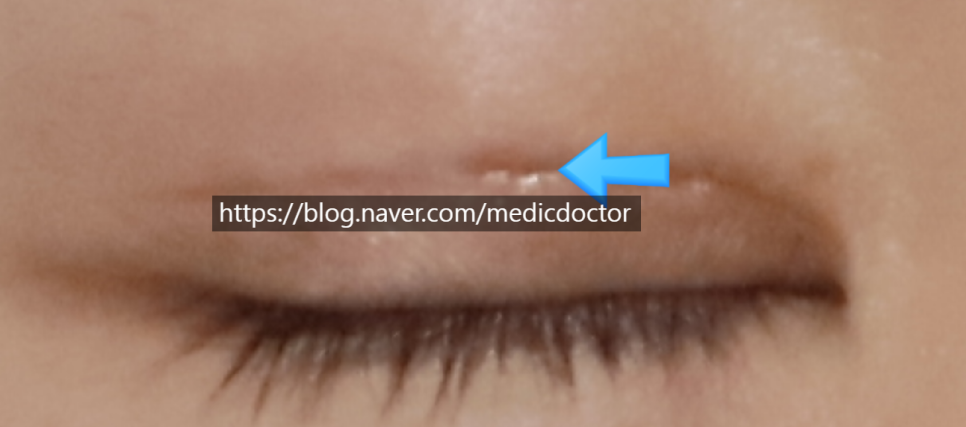
Occasionally one of those internal fixation sutures works its way to the surface.
This happens more often after revision surgery — fine at first, then surfacing later.
The short answer: it's fine. Patients sometimes equate this with the kind of nasal-implant extrusion seen after rhinoplasty and worry it's a surgical error.
It's an understandable concern — these sutures are meant to stay inside, after all.
Removing one causes no harm, and it's not an emergency.
Implant extrusion after rhinoplasty is a different matter, because the shape of the nose actually changes.
After incisional eyelid surgery, removing one of these internal sutures does not undo the crease, so it can safely come out.
Why doesn't the crease come undone, you might ask?
By that point, the internal tissues have fully fused into their new architecture.
About one month is enough for this internal healing to be complete.
Think of it this way: when the skin sutures are removed, the skin doesn't fall apart — same principle.
If a suture surfaces, let your surgeon know and have it removed. Leaving it in place exposes it to outside irritation, and bacteria can travel along the suture to seed a small pustule or local inflammation.
If that happens, removing the suture and draining the pustule resolves it. Most patients heal without any further symptoms.
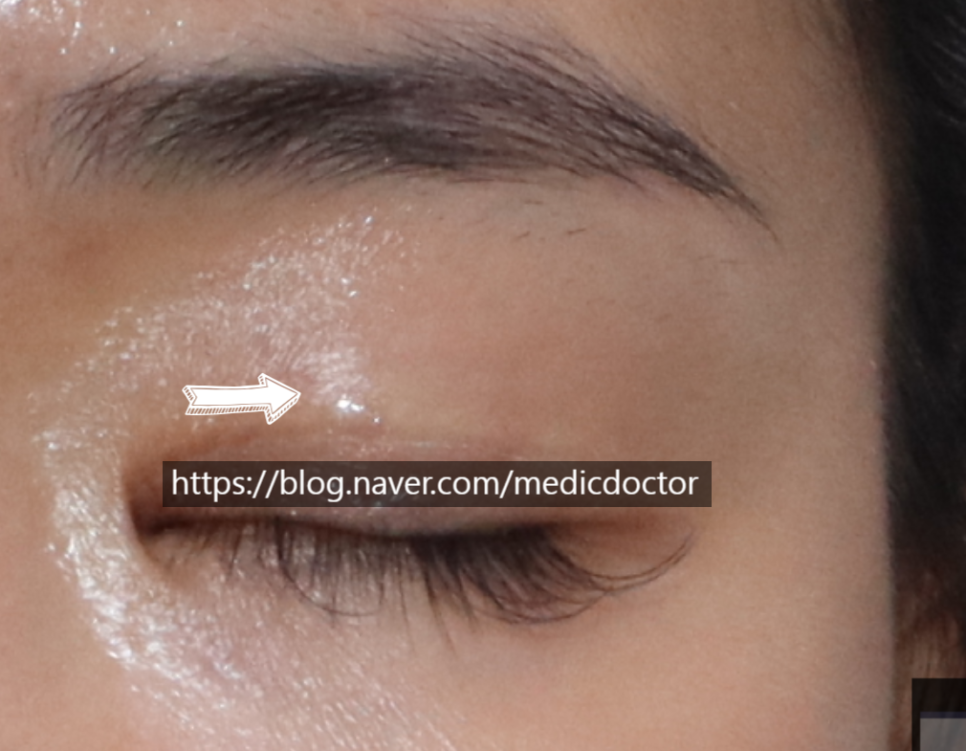
Sometimes a small pustule develops along the incision line.
We can drain the pustule alone, but if there's a nearby internal suture, it's better to remove that as well — bacteria can colonize the suture and trigger repeat pustules.
Healing after this kind of removal is straightforward, so there's no need to worry — see your surgeon.
So why do these sutures surface after incisional surgery? Several reasons.
First, when the patient had a buried-suture procedure before converting to the incisional method. Fragments of the original buried suture can sit quietly for a long time before slowly working their way through the tissue.
Second, internal fixation sutures from the incisional surgery itself can erode through thin tissue. This is more common after revision, where the tissue and overlying scar are already thinned.
Either way, the best course is to trust your surgeon and follow the plan they recommend.
Time to move past the culture of distrust.