
Today's post: how we remove buried sutures, and the misconceptions that surround the procedure.
Buried-suture removal targets the sutures along the existing crease, where they were originally placed.
At our clinic, we use specialized instruments to extract the sutures through tiny pinholes.
Let me walk through a case. This patient had buried-suture surgery at another clinic one week prior.
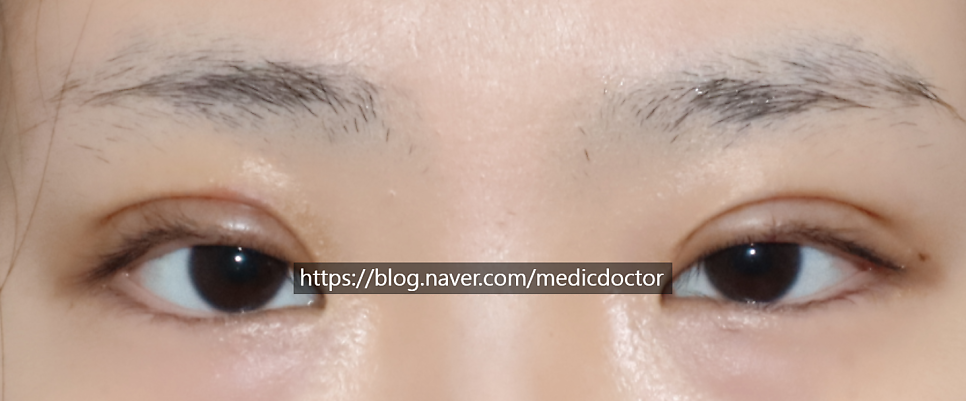
She reports a tight, pulling sensation and difficulty opening the eyes.
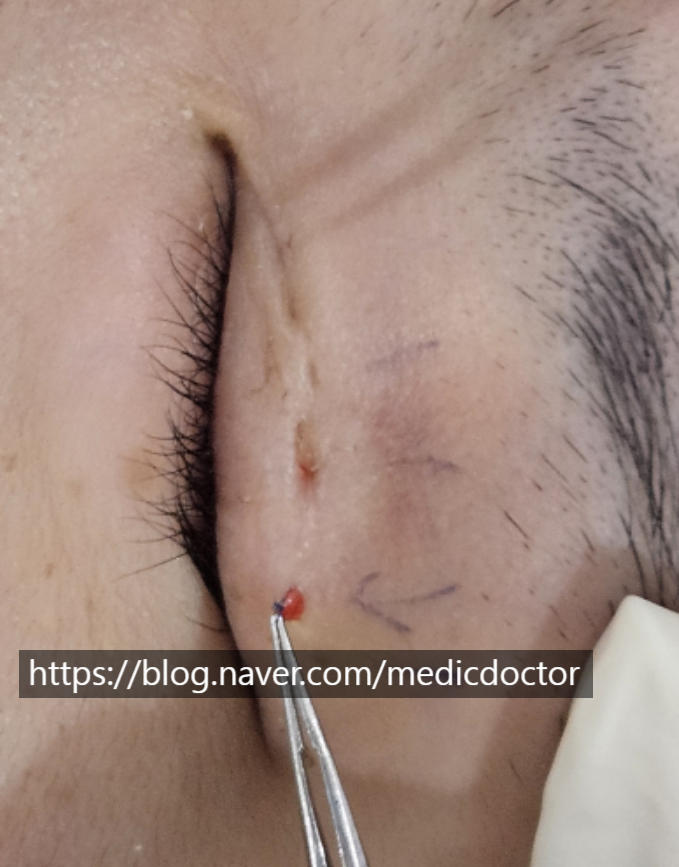
Can you see the suture knot?
We're removing the suture through the original pinhole — no incision required. Patients sometimes ask whether a 1 cm cut is necessary, because their original clinic told them removal couldn't be done through a pinhole.
Opening up the lid certainly makes the suture easier to find — but if you chose the buried-suture method, presumably you did so to avoid an incision in the first place. (And if you're already prepared for an incisional procedure, finding the old sutures becomes a non-issue.)
Before-and-after view of the suture removal.
Most cases take under ten minutes. If a suture truly can't be located, we stop rather than disturb tissue unnecessarily — though with single-knot techniques, I haven't yet failed to find one.
Immediately after removal. Eye opening is markedly easier, and the lid looks much better than before.
Q) After buried-suture removal, will the lid skin sag more?
A) No. The crease lifts and folds the skin, which makes the lid look less ptotic; once that fold is undone, the skin appears ptotic again — but it isn't actually any more so than before surgery.
Q) I've heard removal should be done at the clinic that did the original surgery — is it okay to go elsewhere?
A) Not at all. If that were the rule, every revision would have to go back to the original clinic. Eyelid revision calls for its own specialized skill set, and the procedure should be done by a board-certified plastic surgeon experienced in revision work.
Q) Other clinics told me the suture can't be removed — is it possible here?
A) Buried-suture removal is one of the procedures I perform most often. It typically takes ten to fifteen minutes, with minimal tissue trauma, no incision, and access through a small pinhole. Years of refinement have gone into the technique.
Q) Will the pinhole leave a noticeable scar?
A) We reuse the original pinholes from the buried-suture procedure. The original surgery typically created six small pinholes — clinics vary, with the range usually falling between five and ten.
For removal, we open at most three of those — same size as the originals.
Some patients are at ease with the original pinholes but anxious about reopening them — even though it's the same procedure.
They are the same pinholes.
We close each pinhole with a fine suture so the marks are even less visible.
In most cases, the sutures come out cleanly.
I'm glad the procedure went well.
More on the topic in these posts:
https://blog.naver.com/medicdoctor/223454645816
https://blog.naver.com/medicdoctor/223889539549
https://blog.naver.com/medicdoctor/221788520525
https://blog.naver.com/medicdoctor/222003770118
https://blog.naver.com/medicdoctor/221909551920