Long time no post.
Occasionally, when there is facial asymmetry or one eye is genuinely smaller, we use ptosis correction to bring the eyes closer to symmetric.
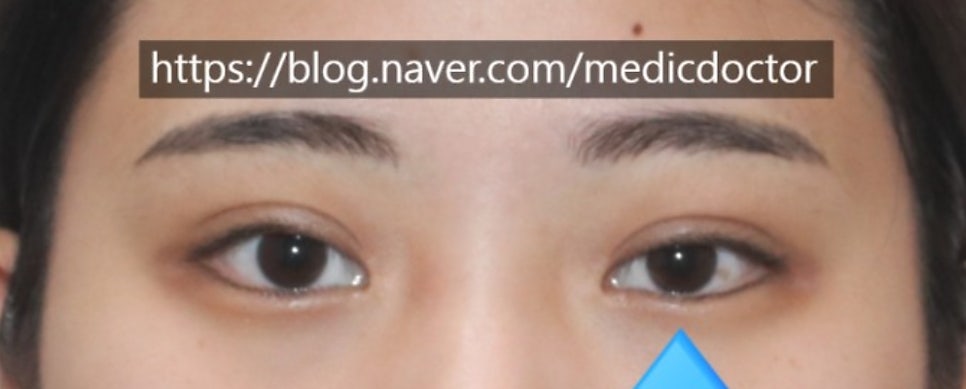
In this patient, the left eye is smaller than the right (arrow on the right side of the photo).
We use ptosis correction to balance the two sides as best we can.
That said, when the asymmetry stems from underlying bony asymmetry, perfect symmetry is not realistic.
Bony asymmetry cannot be fully compensated with soft tissue alone.
Within those limits, ptosis correction can still bring the eyes much closer to matching.
Hering's law of equal innervation can also come into play, with the contralateral lid narrowing after surgery on the dominant eye. In those cases, we have to determine which side is the dominant eye.
I take care of that during the exam, so it isn't something to worry about.
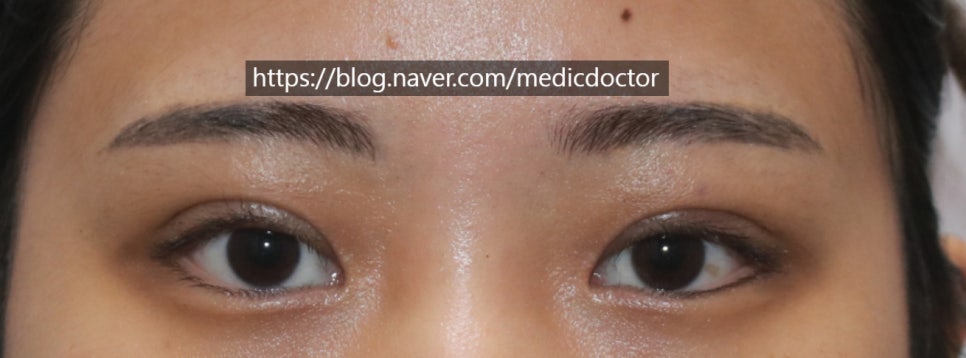
One week post-op. There is still some swelling, but the symmetry is much improved. We operated on only one side — the right side of the photo (her left eye).
Sometimes the asymmetry is volume-related, from the orbital fat.
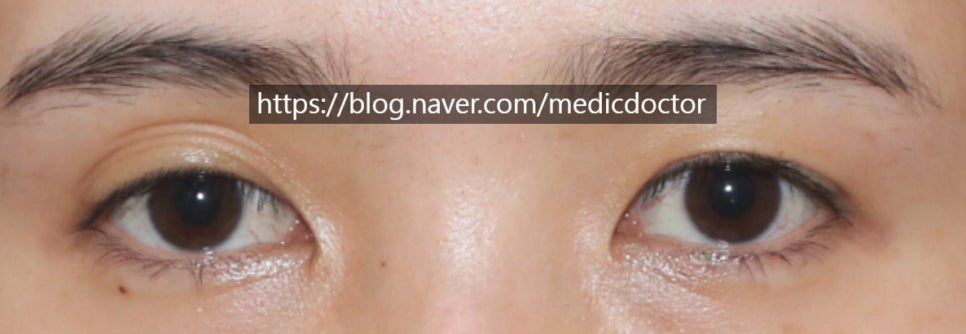
In this patient, the right eye (the left side of the photo) reads sunken because the fat is depleted.
Here we did fat grafting along with double-eyelid surgery.
The skill in fat grafting is making sure the result does not feel lumpy. In thin-skinned patients it can occasionally be palpable, so I prefer to err on the conservative side and place small volumes.
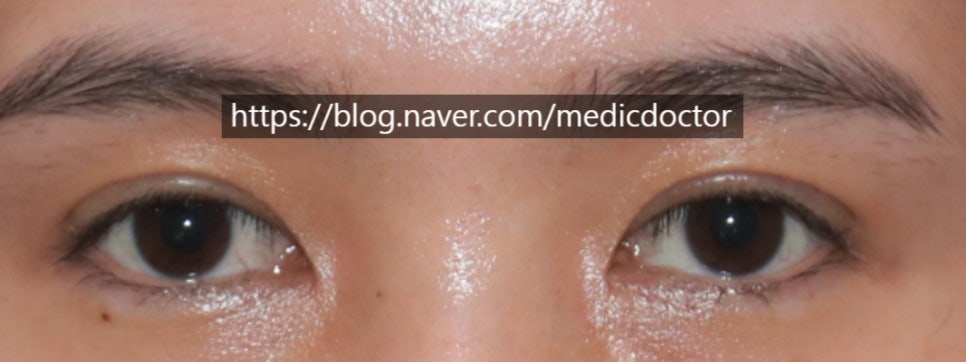
One month post-op. The two sides match well.
Asymmetry correction comes in a wide range of presentations and variables. I will share more cases in future posts.
This material is based on the lecture I gave at the November 2021 Korean Society of Plastic and Reconstructive Surgeons (KSPRS) meeting.