
When I operate on male patients, I see asymmetric eyes more often than people might expect.
It is usually driven by underlying bony asymmetry between the two sides.
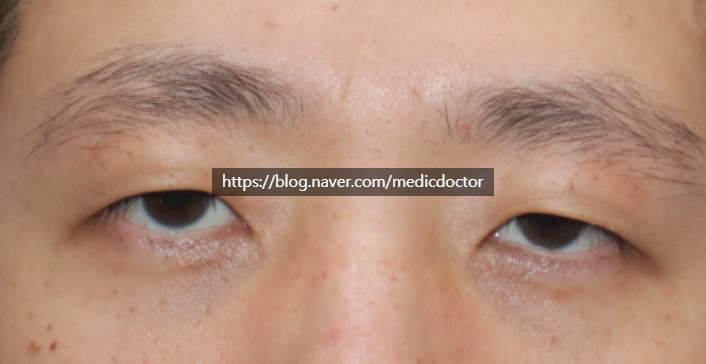
Pre-op he had clear facial asymmetry and noticeably sleepy eyes on both sides.
His underlying skeleton is larger on the right side, so the right brow sits higher as well.
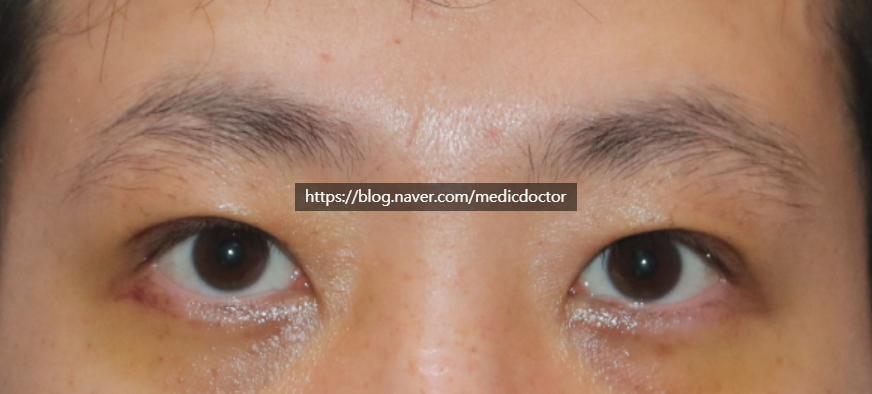
One week post-op, at suture removal.
He can open his eyes well and the asymmetry is largely corrected. The lateral portion is still swollen at one week, so the crease shows; as swelling resolves, the lid skin will drape over and conceal it.
Comparing each eye on its own, the gaze is much sharper than before.
When correcting asymmetric eyes, I match the pupil position first using ptosis correction.
Then I decide on crease size, measure the degree of skin redundancy on each side, and trim accordingly.
It is not so much a technically difficult operation as a labor-intensive one.
The more attention to detail, the better the symmetry — and the better the result.
Male non-crease ptosis correction is where you really see asymmetry play out. Because the goal is a larger, sharper eye without a visible crease, even a small skin redundancy on one side can read as asymmetric, and the planning has to account for that.
An older post for reference.