
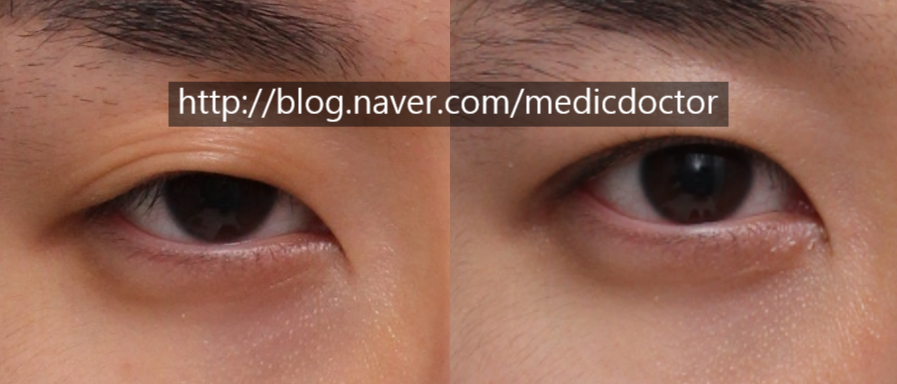
These are my personal thoughts on why non-incisional ptosis correction is rarely the right choice for male patients. The photo above is a patient who had a non-incisional ptosis correction. In both men and women, I reserve the non-incisional approach for cases that meet a fairly narrow set of criteria: a correction of less than 1 mm, no skin redundancy, thin skin with little risk of the suture pulling through, and minimal subcutaneous fat. You can see in the photo above that the skin is thin. Men, however, often have thicker skin and more subcutaneous tissue, and the lid sits heavy. Buried sutures release very easily in those cases. From my own experience, 80 to 90 percent of male patients end up with an incisional ptosis correction or an incisional double-eyelid surgery. Some of the men who do come in for non-incisional work are patients other clinics have already turned away.
When the skin is genuinely thin and a non-incisional ptosis correction holds, that is the best of both worlds for everyone. The patient recovers quickly, and the surgery is straightforward. But if I take the easy path and do a buried-suture correction on a patient who really needs an incisional approach, the work releases within months. The patient has spent the recovery time and the money for nothing.
Honestly, even when an incisional ptosis correction is the better choice, if a patient strongly prefers the non-incisional route I will sometimes go with their wishes, knowing the risk. But for patients whose anatomy makes early failure a near certainty, I cannot in good conscience offer it. The patient pictured below, with this much lid thickness, is simply not a non-incisional candidate.
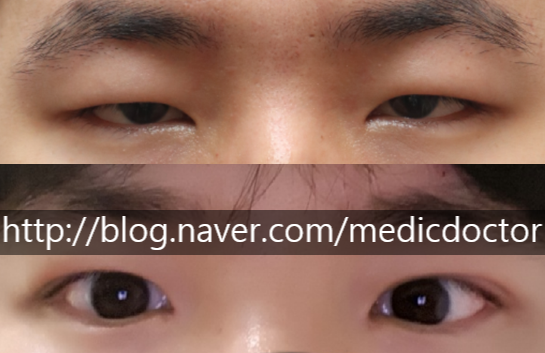
And the incisional approach is not as swollen as people fear. Most of the swelling is gone within a week.