
If your eyes don't close quite right after double eyelid surgery,
if the asymmetry is marked, or if multiple upper eyelid creases have appeared,
you're probably wondering, 'Do I need revision surgery for this?'
In cases like these, rather than simply waiting it out,
it is far more important not to miss the window you are in right now.
Complications after double eyelid surgery, and after ptosis correction in particular,
have a golden window of their own, and we call it 'early revision.'
Today I'll go over exactly what early revision after double eyelid surgery is,
how long the window stays open, and in which situations it is needed,
one point at a time.
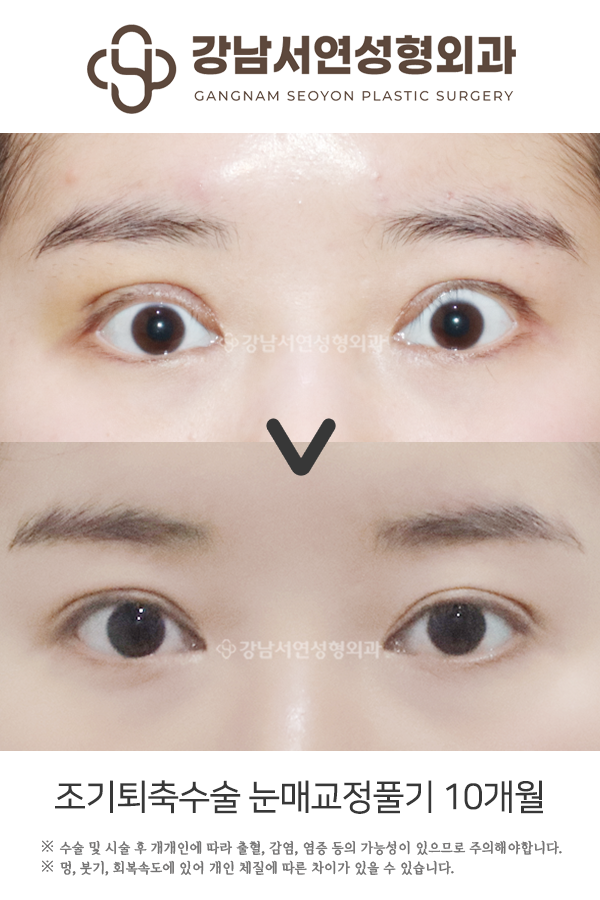
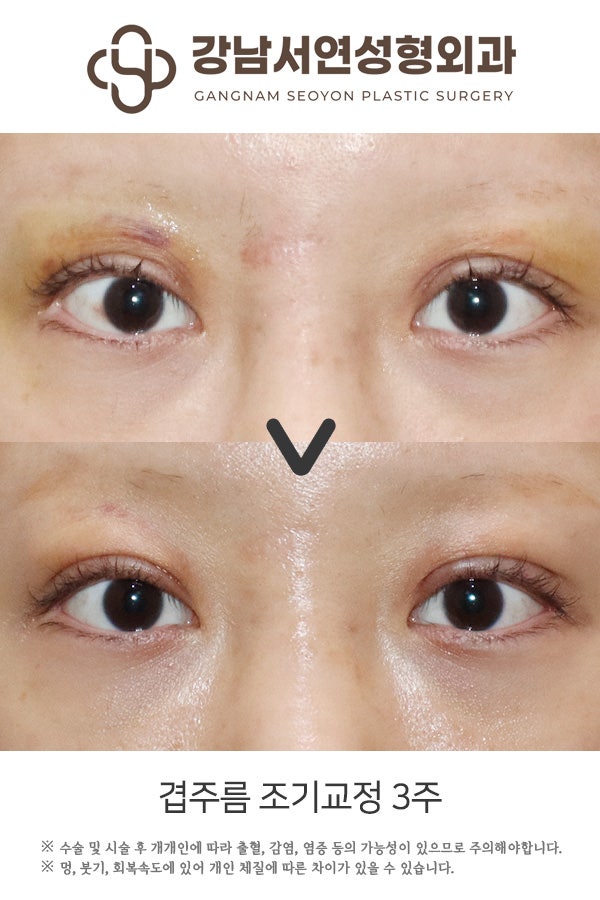
■ What is early revision after double eyelid surgery?
Early revision is a reoperation performed when, right after double eyelid surgery (especially ptosis correction),
the result is unsatisfactory or a functional problem develops,
and it corrects things quickly, before scar tissue and adhesions have settled in.
In general, at least six months are said to be needed after the first operation
before a revision can be considered safe.
Early revision, by contrast, does not wait out those six months;
the whole point is that it is performed far earlier.
■ The golden window for early revision: exactly how long does it last?
The best time is 1 to 2 weeks after surgery.
If we take an aggressive approach, up to three weeks is still workable.
Once about a month has passed, however,
the tissue and the scar have already begun to set,
so if you are past that point, it is safer to wait
and have the revision after six months.
These are not absolute figures.
The rate at which swelling resolves and the degree of tissue stabilization differ from person to person,
so the precise timing should be determined through examination by a specialist,
on a one-to-one basis.
■ Consider early revision in cases like these
- When the two eyes look different in size after ptosis correction
- When the ptosis correction is undercorrected and the effect falls short
- When the ptosis correction is overcorrected and the eye opens excessively wide,
or feels as though it does not close properly
- When faulty adhesion has produced multiple upper eyelid creases
In particular, if overcorrection is keeping your eye from closing fully,
or you have functional discomfort such as tightness or a foreign-body sensation,
don't put it off; get assessed promptly.
■ Can the double eyelid line also be changed with early revision?
To give you the conclusion first: in most cases, changing the line is not feasible.
That's because, around a line that has already been incised,
placing another incision above or below it so soon afterward
leaves the tissue between the old incision and the new one
without an adequate blood supply,
which puts that tissue at risk of necrosis.
So early revision is, fundamentally,
focused on restoring function,
while design changes such as raising or lowering the line
should as a rule wait until after six months, once the incision has healed sufficiently;
that is the principle we work by.
Multiple upper eyelid creases, however, are a somewhat different matter.
Correcting multiple upper eyelid creases means opening the existing line and releasing the adhesion,
so no new incision is added,
which is why it can be dealt with at the early revision stage as well.
Even then, though, the aim is not to refine the line into something prettier;
the priority is eliminating the functional complication.
■ Early revision: procedure details
Operating time: 30 to 60 minutes
Anesthesia: sedation or local anesthesia
Follow-up visits: 1 to 2
Suture removal: 5 to 7 days postoperatively
Hospital stay: same-day discharge
Return to daily activities: 3 to 7 days

The operation itself is not a large one,
but because it requires reading the condition of the existing tissue accurately
and approaching it with real finesse,
it matters that you have it done by a specialist with plenty of experience.
■ Early revision at Gangnam Seoyon Plastic Surgery
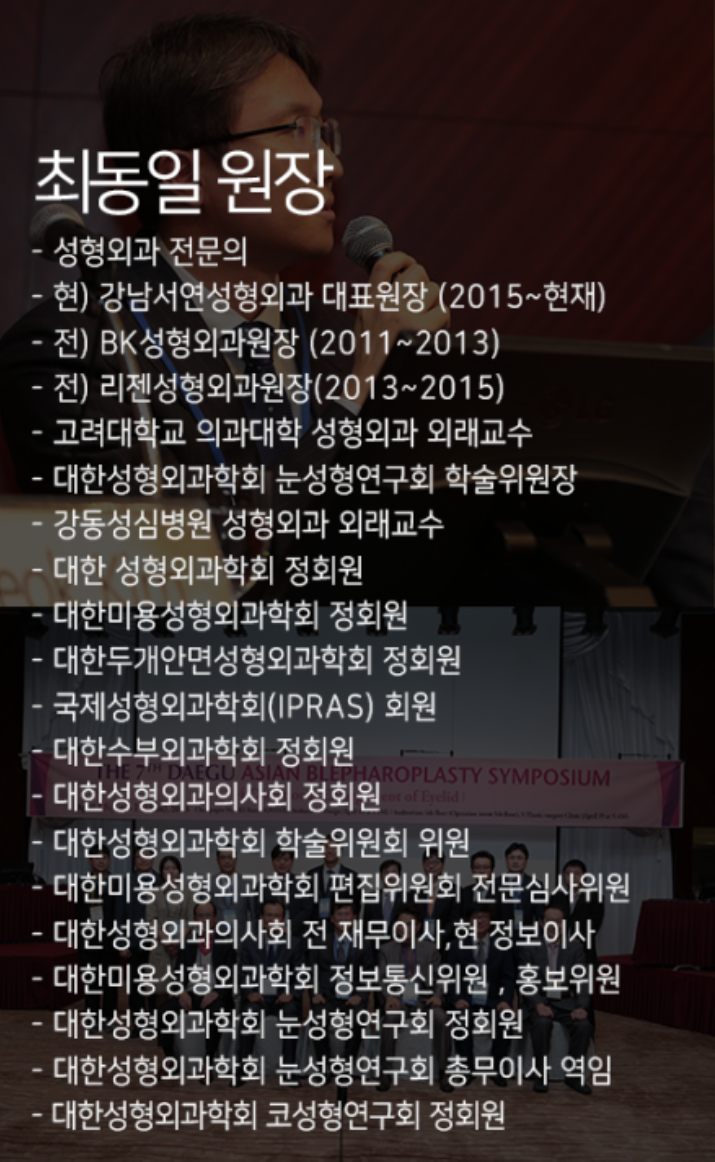
Director Choi Dong-il of Gangnam Seoyon Plastic Surgery,
drawing on more than 22 years of experience in eye revision surgery,
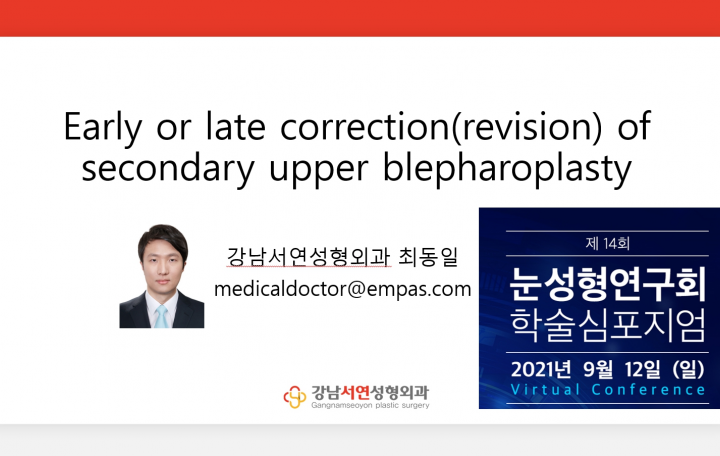
at the 2021 Oculoplastic Symposium of the Korean Society of Plastic and Reconstructive Surgeons,
on 'Early and Late Correction in Double Eyelid Revision Surgery,'
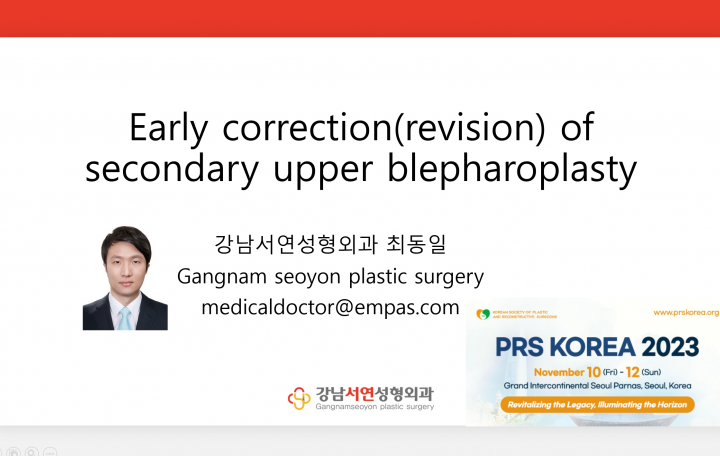
and at the 2023 Asian Oculoplastic Forum,
on the topic of 'Early Correction in Double Eyelid Revision Surgery',
has presented at both.
With early revision, the diagnostic ability to read swelling and tissue condition accurately
is what determines the outcome, so
I recommend consulting a specialist with years of clinical experience
and a track record of presenting at academic societies.
■ Frequently Asked Questions (FAQ)
Q. How long after double eyelid surgery can I still have an early revision?
A. The best time is 1 to 2 weeks after surgery, and with an aggressive approach it is possible up to three weeks. If a month has passed, I recommend a revision after six months.
Q. Can the double eyelid line be changed with early revision?
A. In most cases, no. Placing a new incision around the existing incision line carries a risk of tissue necrosis, so line changes are done after six months. Multiple upper eyelid creases are the exception: since it is corrected by opening the existing line, it can be dealt with at the early revision stage.
Q. Why is early revision better for scarring?
A. Because the correction is made while the tissue is still soft, before scar tissue and adhesions have hardened, recovery is faster and the result looks more natural.
Q. Can I judge for myself whether I'm a candidate for early revision?
A. Swelling and the degree of tissue stabilization are often hard to judge by eye. If you miss the window you will have to wait six months, so if you're worried, the safe course is to get a specialist's assessment quickly.

The photographs in this post were taken under identical conditions with the patient's prior consent.
In addition, side effects such as bleeding, infection, and inflammation may occur after plastic surgery or procedures depending on the individual, so caution is required.